
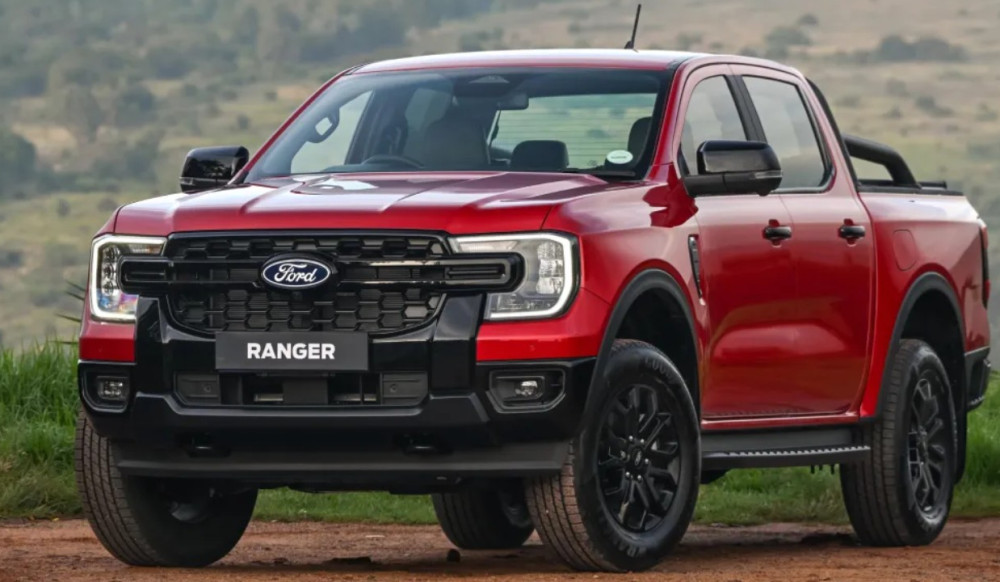
- The biggest change in more than a decade is happening in Q2 for Ford's South African-built bakkies.
- A powertrain change sees the popular and powerful, 2.0 BiT (Bi-Turbo) diesel engine, replaced by the 2.0 SiT (Single-turbo).
- Is a limited edition 2.0 BiT XLT Chill Grey a good buy?
Automotive engineers will tell you that the best time to buy a successful and popular model is towards the end of its lifecycle. But why?
Supply chain and tooling maturity are the main reasons. As economies of scale and deep quality control mature across a vehicle range, build quality often improves. Especially if it's a very popular and successful model.
That's why the Ford Ranger is so topical. One of South Africa's most popular vehicles, the Ranger is locally built. And the current T6.1 Ranger, is due for a very significant upgrade over the next few months. With the model matrix changing, as it retires one of Ford’s most popular engines.
If the traditional product lifecycle wisdom is to buy the best-built versions of a vehicle as late as possible in its lifecycle, how does that apply to the Ranger's engine line-up change? We have the insight to help you decide whether to buy one of the 'final' Ranger 2.0 BiT bakkies or wait for the new 2.0 SiT, which should become available at dealers by May 2006.
Buy the best new or used Ford Ranger on ChangeCars
Are you a lifestyle or heavy-duty buyer?

Bakkies have moved upmarket. A lot. The high-trim double cab bakkie is now a luxury family vehicle, which hardly does the load or towing duties that legacy bakkies did. For decades.
It's important to understand what your driving cycle and needs are, with a Ranger. Are you a lifestyle buyer who wants the all-terrain driving confidence and the sense of safety in traffic from the elevated driving position? Or do you need a bakkie that can also tow a boat trailer, a horsebox, or a caravan? Because those are two very different things.
The Ranger 2.0 BiT engine was developed as a replacement for the 3.2 turbodiesel, which was very good at towing due to its large displacement, but was a bit heavy on diesel. The smaller 2.0 BiT leveraged the latest powertrain tech, using two turbos and advanced lubrication to reduce friction and enhance efficiency.
But there is risk with the 2.0 BiT engine design. It's powerful and responsive for its size and delivers a very smooth, efficient, highway-driving experience. Wet belt timing can fail prematurely, risking additional damage to engine components. Timing chains (very) rarely snap, but belts are more likely to fail catastrophically, if they are degraded.
What's your risk?

No two bakkie owners have the same driving patterns. If your Ranger 2.0 BiT only operates as a family vehicle, driving kids to school, and taking the family on long weekend getaways and year-end road trips, it's never going to tow its 3500kg maximum braked capacity. And that's important.
The truth is that most South African lifestyle bakkie owners who live in cities are not going to tax their engines. If you are only loading garden refuse or mountain bikes into the loadbin over a weekend, that's hardly 50kg of weight. And your Ranger isn't working hard, at all.
But hauling 3500kg trailers and caravans up steep mountain passes, is what creates a lot of power and drivetrain wear. And if you are never going to use your 2.0 BiT for that, the likelihood of accelerated wetbelt wear is low.
Buy the best new or used Ford Ranger XLT on ChangeCars
Should you wait for the 2.0 SiT?

Ford's engineers have transitioned from a wetbelt to chain-linked camshaft timing for the new 2.0 SiT engine.
You will sacrifice overtaking acceleration and highway cruising performance. That's just the reality of physics, because the 2.0 SiT is 18kW less powerful. And that difference in power isn't really apparent at low speeds, when you are edging along in traffic, but it does make a real difference at the peak power delivery curves, at higher speeds, when you need to overtake slower traffic.
The 2.0 SiT will be more durable. Chain-driven engine timing is proven, and there's a reason it is used in heavy-duty applications like military vehicles and trucks. So, if you are buying a Ranger double cab and heavy towing is a feature of your monthly driving schedule, the 2.0 SiT might be slower, but its component configuration (camshaft timing chain instead of belt) is less prone to premature wear or failure under severe loads.
Buy the best new or used Ford Ranger XLT on ChangeCars
Is the XLT Chill a good buy?

With most production runouts, there is a limited-edition marketing push. And Ford South Africa is doing exactly that, with its best version of the Ranger 2.0 BiT engine range, for real-world buyers. The XLT.
If you want one of the last XLT double cabs, with the 2.0 BiT engine, Ford is making 250 Chill Grey versions. With a surprising amount of added content.
What do you get with one of these XLT Chill Grey bakkies? A trick grey paint finish that works spectacularly well with the Ranger's overall design and proportions. But also an upgrade to all-terrain tyres on 17-inch wheels.
Every true adventure driver knows that 17-inch wheels with high-volume, reinforced-casing tyres are ideal for real-world bakkie conditions in South Africa. Particularly those long, corrugated dirt-road routes. Where having a proper all-terrain tyre matters.
Ford has also added underbody protection to enhance the XLT Chill Grey’s confidence in venturing into challenging terrain. And there's a cabin upgrade to leather seats, steering wheel, and shifter, to give the XLT Chill Grey a premium feel unlike any other XLTs, which are usually utility-grade in the Ranger line-up.
So, if you always wanted a 2.0 BiT Ranger double cab, you can now get one of the last ones, in XLT grade with a lot of additional content that matters.
Insights by Lance Branquinho